
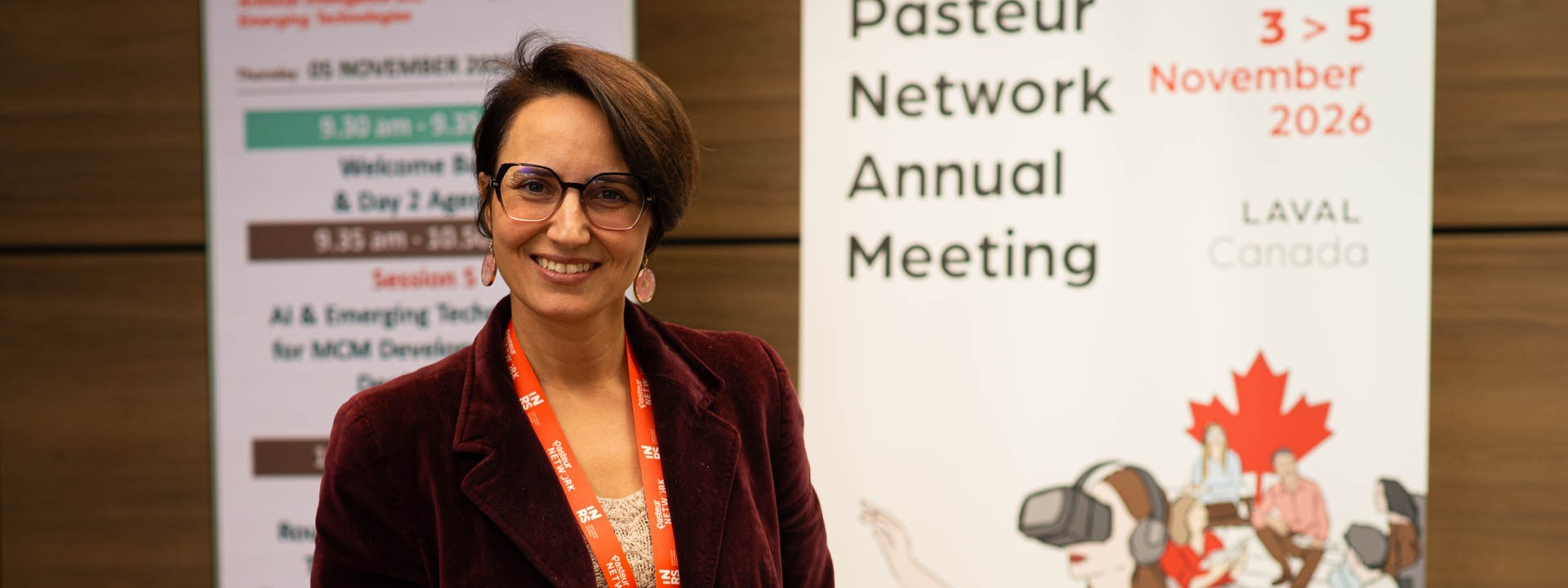
Dr. Emna Harigua receives the Talent Award: Artificial Intelligence Edition with a project on AI-driven drug discovery
At the occasion of the Pasteur Network Annual Meeting (PNAM), Dr. Emna Harigua, Research Team Leader at the Molecular Epidemiology and Experimental Pathology Laboratory of the Institut Pasteur de Tunis, received the Talent Awards on Artificial Intelligence.
Funded since 2017 by the Institut Pasteur Paris, the award highlights young researchers from the Pasteur Network who have shown strong scientific potential. In line with this year’s focus on Artificial Intelligence, the prize honors young researchers who demonstrate a sense of innovation in the use of Artificial Intelligence tools.
A career built at the crossroads of AI and biomedicine
Dr. Harigua’s research took a new direction in 2019, when she began integrating AI into drug discovery and other medical research applications. In 2020, she founded AI4HD, a startup that develops digital tools to bring the benefits of AI to health workers and clinicians. She now leads a team at the Institut Pasteur de Tunis developing bioinformatics and AI-based approaches for biomedical research, supported by grants from USAID, EU-H2020, AAS, IDRC and SFA. Her most recent funding, the highly competitive ARISE grant of the African Academy of Sciences (EU-African Union funds), supports BIND, an AI-based drug discovery platform. Through the project, they’ve already identified nine novel anti-leishmania drug candidates, three of which are now in preclinical studies and validation.
Making AI work for neglected disease research
Dr. Harigua was selected for a project that uses AI to help design new drugs against leishmaniasis. AI is changing how drugs are discovered: it can scan huge numbers of possible molecules and predict how they will behave in the body. But most of these tools are trained on the large, high-quality datasets of the pharmaceutical industry, which are rarely available for neglected diseases. As a result, they often work poorly in this field. Dr. Harigua’s project addresses this by building AI algorithms that work with limited data, use medicinal chemistry knowledge, and show how reliable each prediction is on assessing anti-leshmania treatment.
A recognized voice in the scientific community
Dr. Harigua’s work has earned numerous distinctions, including the President Award for Best Female Research at the International Development Research Centre (2025), the UNESCO-L’Oréal International Fellowship for Women in Science (2012), and fellowships from the American Society of Tropical Medicine and Hygiene. She also serves as a reviewer for international funding agencies and sits on several scientific committees.